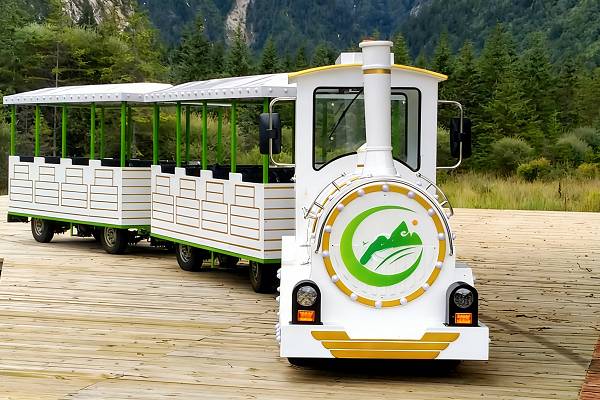
Battery trackless trains are quieter and cleaner, and in most parks they are the right answer. Diesel still wins in a specific set of circumstances: long routes, heavy loads, steep gradients, limited charging infrastructure and days that run from early morning until late at night. This guide explains when a diesel trackless train for large parks is the better choice for a large outdoor site, and what to check before ordering.
Measure the Daily Duty Cycle First
Write down the route length, the number of stops, the gradients and the hours the train will run. A large outdoor park with a five-kilometre circuit and eight boarding points draws far more energy than a compact zoo loop, and the difference decides whether a battery pack can complete the day with a mid-day charge or whether the park would need a second train to cover the gap. Diesel removes that constraint because refuelling takes minutes rather than hours.
When the Route Is Long and Exposed
Long routes across open ground expose the fleet to wind, sun and rain, and a large outdoor park often wants enclosed or semi-enclosed carriages that add weight. Weight reduces range. Diesel trains handle that combination without a redesign, and a model such as a forty-seat diesel trackless train for resorts shows how much seating can be carried on a single unit when the power source is not the limiting factor.
When Charging Infrastructure Is Limited
Battery operation is only as good as the charging regime behind it. If the park has no suitable power supply at the depot, no covered charging bay and no technician available to manage battery health, a battery fleet will disappoint in its second season. Diesel avoids that investment, needing only a compliant fuel store, a safe refuelling point away from guests and a maintenance regime the park can staff today. Compare the available trackless train models against the infrastructure you can realistically build.
Noise, Emissions and Guest Zones
Diesel brings noise and exhaust, which matters more in animal enclosures, indoor areas and quiet gardens than on an open route through a large park. Map the route against the zones where guests stop to listen or watch, and choose the stopping points so that engines idle away from those areas. Modern diesel locomotive design has reduced both noise and emissions considerably, but the park still has to plan refuelling, ventilation and driver procedure around them.
Operating Cost and Servicing
Compare five-year costs rather than purchase prices. Diesel requires fuel, oil and filter servicing, while battery fleets require electricity, pack replacement and more careful handling. On routes where a battery train cannot complete the day, the true comparison is between diesel and a larger battery fleet with spare units, and diesel usually wins on both capital and labour in that scenario. A diesel trackless train for sale should be evaluated with a written servicing plan covering intervals, spare parts and the skill level of your workshop.
Ordering the Right Configuration
Finally, specify the train for the park rather than for the catalogue. Ask about engine size, towing capacity, carriage mix, canopy options and braking for gradients, and request a commissioning plan. Where a park expects to grow, a supplier such as Dinis diesel train company can advise on a configuration that can be extended later without replacing the locomotive.
Diesel is the right choice when the route is long, the loads are heavy, the operating day is long and the charging infrastructure is not realistic. Measure the duty cycle, review the route, check the zones where noise matters, compare the five-year cost and specify the configuration properly. The models are listed at https://www.dinistrains.com/diesel-trackless-train-for-sale/.