Planning a water park starts with one unavoidable question: how much does it cost to build a water park before a single ticket is sold. Owners who answer that question early avoid the most expensive mistake in the industry – buying equipment before the site, the water treatment capacity and the operating budget have been worked out together.
The honest answer is that a realistic water park investment cost depends on four variables: the size of the site, the mix of attractions, the local cost of construction labour, and the standard of finish you choose for guests. This guide breaks the initial investment down item by item so you can build a defensible number for your own project.
The Short Answer: Water Park Investment Ranges
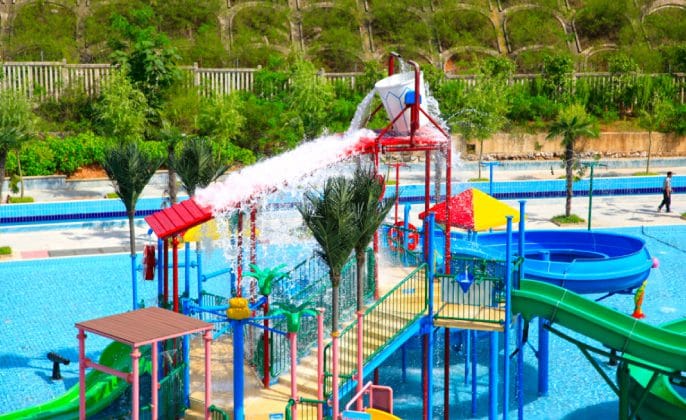
A small neighbourhood or hotel water park of roughly 1,000 to 5,000 square metres – a splash pad, two or three body or raft slides, a leisure pool and basic changing rooms – typically requires USD 250,000 to 1,200,000 of total capital expenditure. A mid-size commercial water park of 5,000 to 20,000 square metres with a wave pool, multi-lane racer slides and food and beverage outlets generally lands between USD 1.5 million and 6 million. Destination-scale parks above 20,000 square metres start at USD 8 million and rise quickly once themed structures and large wave pools are added.
What Drives the Initial Investment
Every water park budget can be split into six blocks. Understanding the weight of each block is how you control the water park construction budget instead of discovering it halfway through construction.
Land, Earthworks and Site Preparation
If land is already owned, earthworks are usually 8 to 15 percent of the total. Sloped sites cost more because of retaining walls and cut-and-fill. Flat sites with good drainage cost least. Access roads for equipment deliveries should be planned at this stage – a 12 metre slide section cannot be craned into place through a narrow garden path.
Water Park Equipment: Slides, Splash Pads and Wave Pools
Attractions are the largest single line, normally 35 to 55 percent of the project. Body slides are the most economical per guest, raft slides cost more but carry higher throughput, and wave pools are the most capital-intensive single element. Splash pads with interactive play structures are the cheapest way to add capacity for young families. Slide shells are built from FRP – glass-reinforced plastic – which is why surface quality, resin grade and gelcoat thickness matter more than the colour of the ride.
Water Treatment, Filtration and the Plant Room
Filtration, disinfection, balance tanks, pumps and pipework typically account for 10 to 18 percent. This is the block owners most often under-budget. Turnover rates are set by local health codes: a wave pool may need a complete water turnover every two hours, which dictates pump size, pipe diameter and the area of the plant room itself.
Buildings, Changing Rooms, Food and Beverage
Entrance buildings, family changing rooms, lockers, shaded seating, retail and food outlets usually represent 12 to 20 percent of capital expenditure. Food and beverage space is expensive to build but it is also the fastest area to generate secondary revenue, so it should be sized for peak weekend demand rather than average attendance.
Permits, Engineering and Installation
Design fees, structural and hydraulic engineering, permits, inspections and installation supervision are normally 6 to 12 percent. Import duties, freight and local labour vary enormously by country and should be quoted separately rather than estimated as a percentage.
Pre-Opening Costs: Staff, Marketing and Consumables
Allow 5 to 10 percent for lifeguard recruitment and certification, uniforms, point-of-sale systems, opening marketing and the first stock of chemicals and consumables. A park that opens without a trained lifeguard team and an operating manual cannot legally open at all in most markets.
Investment Ranges by Park Size
| Park size | Typical attractions | Indicative total investment (USD) |
|---|---|---|
| 1,000 – 3,000 m² | Splash pad, 2 body slides, paddling pool | 250,000 – 700,000 |
| 3,000 – 8,000 m² | 3 – 4 slides, leisure pool, kids zone, cafe | 700,000 – 1,800,000 |
| 8,000 – 20,000 m² | Multi-lane racer, raft slide, wave pool, F&B | 1,800,000 – 6,000,000 |
| 20,000 m² + | Destination mix, themed structures, multiple pools | 8,000,000 + |
Where Owners Can Save Money Without Cutting Safety
- Phase the build: open the splash pad and two slides first, then reinvest season one revenue into the wave pool.
- Standardise slide types so the same spare parts and the same maintenance training cover the whole park.
- Buy the water treatment plant for the final phase at the outset – retrofitting pipework is far more expensive than sizing it once.
- Use local materials for landscaping, paving and shade structures while keeping ride hardware and filtration specified to international standard.
- Keep the plant room accessible and well ventilated; serviceability reduces lifetime cost more than a cheaper initial layout.
Payback and Revenue Expectations
Well-run small water parks in warm climates typically target payback in three to five operating seasons. Revenue comes from day tickets, season passes, group and school bookings, food and beverage, and cabana or shade rentals. Season passes should be priced to fill weekdays when fixed costs are already paid. Model the number pessimistically: a park designed for 1,000 guests per day should still be profitable at 350.
Frequently Asked Questions
How much does it cost to build a 1,000 square metre water park?
A splash pad with two body slides, a paddling pool and basic changing facilities on a prepared site typically falls between USD 250,000 and 500,000 for the attraction package, plus land works and local installation.
Is a wave pool worth the investment?
A wave pool is the strongest single attendance driver in a mid-size park, but it also carries the highest water treatment and staffing load. It makes sense above roughly 8,000 square metres of water park area.
How long does construction take?
Design and permitting usually take two to four months, production of slides and filtration equipment four to eight months, and site installation six to fourteen weeks depending on scope and weather.
Planning a Water Park Project?
We supply complete water park solutions from Dinis – attraction selection, hydraulic and filtration design, production, shipping and installation supervision. As a water park equipment manufacturer working directly with owners, we quote the attraction package and the plant room together so the numbers hold up on site. To see how the cost blocks above translate into a real project, read more here or send us your site plan and target opening date.